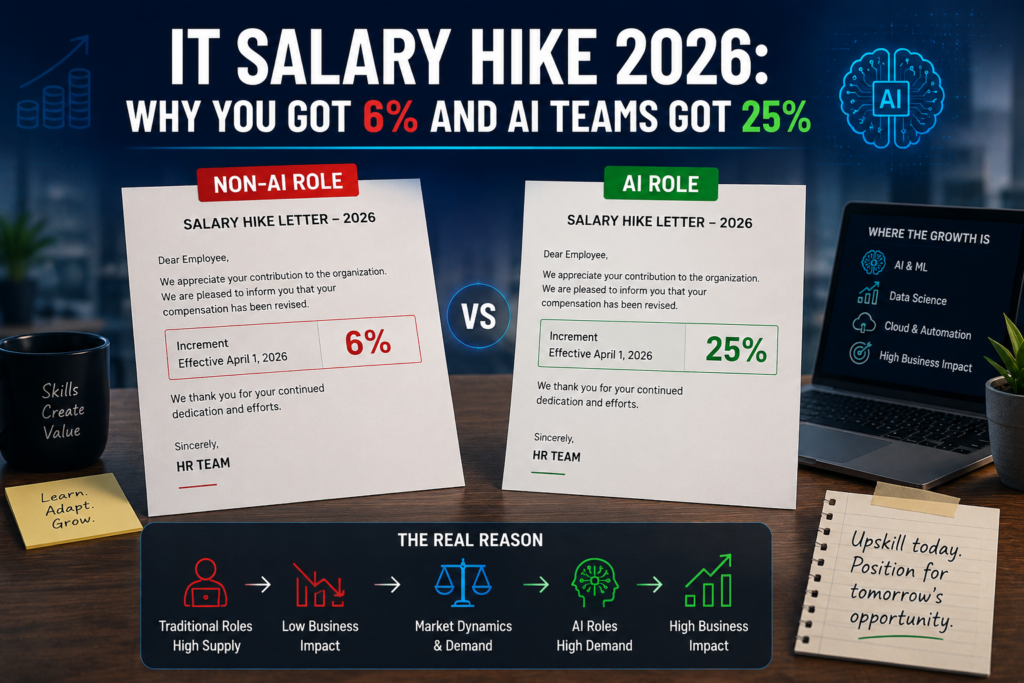
Quick answer: The IT salary hike 2026 cycle is the leanest since 2020 — broad-base increments of 4.5–8% at TCS and Infosys and 6–9% at Wipro and Cognizant — while engineers with AI skills are negotiating 18–35% in-role raises, and studies peg the AI-skills pay premium as high as 54%. The gap isn’t a bad year. It’s a repricing. Here’s the data, and the three ways engineers are responding.
Somewhere on your floor this month, two hike letters landed.
Same joining year. Same band. Similar ratings, honestly. One letter said 6%. The other — the one belonging to the person who moved onto the GenAI workstream last year — said something in the twenties. Both people opened their letters quietly, and only one of them updated their resume that evening.
If you got the first letter, this post is for you. Not to sympathize — you’ll find enough of that on Grapevine — but to show you what the numbers actually say about why this happened, and why waiting for next year’s cycle to fix it is the one response guaranteed not to work.
The numbers, so we’re not arguing with feelings
Start with what’s official and public. TCS announced broad-base increments of 4.5–7%, with double-digit raises reserved for top performers. Independent trackers watching all the majors put the 2026 cycle as the leanest since 2020: TCS and Infosys averaging 5–8% for the general population, Wipro and Cognizant in the 6–9% band, with Infosys delaying parts of its cycle altogether.
Now the other column. The same reports show TCS and Wipro running special raises to hold AI talent, with AI-specialised engineers negotiating 18–35% hikes without changing employers. EY’s Future of Pay 2026 report projects 9.1% average increments across India Inc but says the quiet part in its own headline: compensation is becoming “sharper, more skills-led.” GCC increments are projected to lead the market at above 10%. And an AWS-commissioned study puts the pay premium for AI-skilled workers as high as 54%, with IT among the sectors benefiting most.
Put side by side:
| Profile | 2026 increment reality |
|---|---|
| Broad-base services role (delivery, support, legacy stacks) | 4.5–9% |
| Top-rated performers, same roles | 12–15% |
| Niche skills: AI, cloud, security (in-role) | 15–35% |
| AI-skilled, moving to product companies / GCCs | Premiums studies put up to 54% |
One market. Two economies. Your rating decided very little; your stack decided almost everything.
Why this isn’t just a bad year
It’s tempting to file this under “margins are tight, next year will be better.” The evidence points the other way — the gap is structural, and three things built it.
Billability got a countdown. The same companies compressing your hike have tightened deployment maths — TCS now expects around 225 billable days a year with bench time capped near 35 days. When a company manages people as billable units, it pays for units it can bill at premium rates. Commodity skills bill at commodity rates. The hike letter is just that spreadsheet talking to you politely.
The demand moved, permanently. Clients aren’t asking for more of what services companies staffed for 2015 through 2022. They’re asking for GenAI systems — and the layoffs that hit mid and senior grades this year were the blunt version of the same message this hike cycle delivers gently. Same signal, different volume.
GCCs changed who you’re compared against. With capability centres leading pay growth above 10% and hiring in the same cities, your employer isn’t benchmarking your salary against your colleagues anymore. It’s benchmarking against what it must pay to stop the AI-skilled from leaving. If your skills aren’t the contested ones, there’s no bidding war over you — and no bidding war means no budget.
I saw this dynamic from the other side of the table during my years at Google: compensation conversations were never really about the person’s tenure. They were about how replaceable the skill was that quarter. Indian IT has now adopted that logic at scale, without announcing it.
The three responses, honestly costed
Response one: absorb it and wait. The comfortable option, so let’s do its maths. ₹12L growing at 6% becomes about ₹14.3L after three cycles — ₹2.3L of progress in three years, before inflation eats most of it. Meanwhile the colleague who repriced sits in the other column compounding from a higher base. Waiting isn’t neutral; it’s a slow, polite no to your own future income. Ask anyone who waited out 2020–2023.
Response two: switch companies, same stack. The classic move — resign, collect a 15–20% joining bump, repeat in three years. It still works, once. But you arrive at the new company as the same commodity profile, re-enter the same 6–8% column, and you’ve spent your job-change card without changing your column. The 2026 twist: with 92,000+ tech layoffs already this year, commodity-profile switching is more crowded and slower than the LinkedIn success posts suggest.
Response three: change the column, not just the company. The 18–35% raises aren’t going to people with more years. They’re going to people who moved their skills to where demand outruns supply — production GenAI work: retrieval systems, agents, evaluation, deployment. That switch has a real cost: six-plus months of structured evening work, detailed in the TCS and Infosys switching guides on this site. It’s the only response where next year’s letter is decided by you rather than by a normalization curve.
Don’t take my word for the premium — check it
I run a training company; assume my incentives and verify independently. It takes twenty minutes. Open five current “AI engineer” job descriptions from product companies or GCCs in your city and note the CTC ranges against your band on AmbitionBox. Then open five JDs matching your current profile and compare. The two columns in this post will reappear in your own tabs — or they won’t, in which case ignore everything I’ve said. That’s the test any honest claim should survive, including ours: our program’s full fee terms are public for exactly this kind of checking.
Who should sit tight this year
Balance, because this isn’t for everyone: if a promotion is realistically one cycle away, collect the title first — it travels. If your company has put you on genuinely current AI work in the last six months, you may already be drifting into the better column; push for the in-role correction before doing anything dramatic. And if your finances can’t absorb six months of disciplined preparation alongside a full-time job, fix that first. The gap will still be there next quarter. It’s not going anywhere — that’s rather the point.
FAQ
Why are IT salary hikes so low in 2026?
Margin pressure plus a structural shift: pay budgets moved from across-the-board increments to targeted retention of scarce skills. Trackers place the broad base at 4.5–9% — the leanest cycle since 2020 — while AI, cloud and security skills absorb the freed-up budget.
How much more do AI skills actually pay in India?
In-role raises of 18–35% are being reported for AI-specialised engineers in 2026, and an AWS-commissioned study estimates pay premiums up to 54% for AI-skilled workers. Verify against live listings for your city and experience level rather than trusting any single figure.
Should I change companies or change skills?
A company change with the same skills buys one bump and returns you to the low-hike column. A skills change moves the column itself. The highest-leverage sequence for most service-company engineers: build the AI skill set first, then switch — the offer reflects both.
Will hikes recover next year?
For commoditized roles, nothing in current data suggests it — compensation reports describe pay becoming more skills-differentiated, not less. Plan on the gap widening, and position accordingly.
Prateek Jain is the founder of Nuviq AI and previously worked on Google’s AI Platform. Nuviq runs a 12-week applied AI engineering program with pay-after-placement terms — fees published here. If this year’s letter stung, start with the free plan in the TCS guide above — decide about courses later.