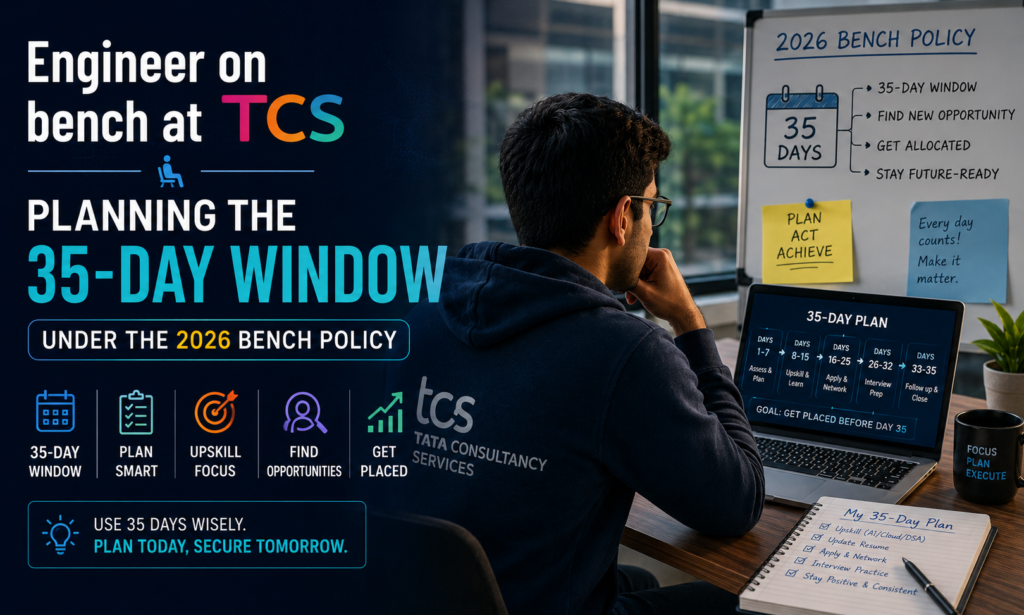
Since June 2025, TCS policy requires associates to stay billable for at least 225 business days a year, capping bench time at roughly 35 business days — with unallocated time explicitly linked to compensation, promotions, overseas deployment and “continuity of employment.” Infosys runs a softer train-then-deploy model with about a three-month grace period. This is a day-by-day plan for using that window instead of losing it.
There was a time when bench at TCS meant catching your breath. Finish a brutal release, sit unallocated for a quarter, do a certification or two, wait for RMG to call. Everyone knew someone who’d been on bench for six months and retired peacefully years later.
That arrangement is gone, and it’s important to be precise about how gone.
What the policy actually says
The deployment policy that took effect on June 12 last year — issued by the global head of the Resource Management Group — requires associates to be billed for a minimum of 225 business days per year. Do the arithmetic against a working calendar and the bench allowance comes out to about 35 business days. Roughly seven weeks. Ever, in a year — not per stretch.
The consequences aren’t left to imagination either. The policy language warns that extended unallocated time will adversely affect compensation, career growth, future overseas deployment and — the phrase worth reading twice — continuity of employment. Business press translated it bluntly: no project, no pay hike, and beyond that, no guarantees.
Three operational details matter just as much:
- Bench means office. Physical presence is mandatory while unallocated; work-from-home needs prior RMG approval.
- Bench means study, on the record. Associates without allocation are expected to spend four to six hours a day on internal learning platforms — iEvolve, Fresco Play and the rest, including the GenAI interview-coach tool.
- Gaming it is watched. Stringing together frequent short assignments to reset the clock invites HR scrutiny. The system is designed to notice.
Add the context of the 12,000-role reduction that hit mid and senior grades, and the picture is coherent: the bench stopped being a waiting room and became an assessment period with a countdown attached.
If you’re at Infosys: softer clock, same direction
Infosys went out of its way to say it isn’t copying this. Its model is “we train, then deploy” — unallocated people go through structured learning and get roughly a three-month grace period before harder conversations begin.
Three months instead of seven weeks is real breathing room. It is not a different destination. Infosys is the company that terminated over 300 trainees for failing internal assessments — the skills-checked-on-a-schedule culture is fully alive there; the timer just starts slower. I’ve written a separate guide for Infosys engineers moving into AI work; everything below applies with dates stretched.
Days 1–7: find out where you actually stand
The first week is for information, not panic-applying.
Get your RMG picture straight. Which accounts have open demand for your skill tag? Is your profile even circulating, or is it stuck behind an outdated skill matrix? Update your internal profile the way you’d update a resume — most people on bench are being matched against a profile they last touched three years ago. Then talk to your RMG contact like a person. They match hundreds of profiles; the ones who get calls are the ones who made themselves easy to place.
Run an honest audit the same week. Open five current job descriptions for the role you’d want outside — AI engineer, data engineer, platform engineer, whatever fits your history — and list every skill you couldn’t demonstrate in an interview this Friday. That list, not the RMG queue, is your real situation. For most service-delivery engineers the list has the same entries: current Python, anything GenAI beyond a prompt, deployment, and evaluation. That’s fixable. Seven weeks is genuinely enough to move the needle; it is not enough to waste a fortnight pretending the list is shorter.
Days 8–25: run both tracks at once
The mistake is choosing between “get allocated” and “prepare to leave.” Run both. They feed each other.
Internal track. Do the mandated learning hours — you have to anyway — but do them with intent. Pick the internal courses that map to billable demand and external value: GenAI, cloud, data engineering. Skip anything you’re doing only to look busy on a dashboard. Then make deployment easy: tell your RMG contact specifically what you’ve just certified in, and say yes to interviews for adjacent roles even at eighty percent fit. An allocation resets your clock and pays for everything else.
External track — evenings and the leftover hours. Internal certificates alone won’t clear an outside interview; the platforms know you, the market doesn’t. Build one small, real thing during these three weeks — the messy-document RAG project I’ve described step-by-step in the TCS to AI engineer guide is designed for exactly this window — and put it on GitHub with a README that admits what broke. One built project changes the texture of every conversation that follows, internal and external. You’re no longer a profile with certificates; you’re someone who ships.
One boundary, stated plainly: build on your own machine, on your own time, on public data. Nothing from client environments, ever. The project is evidence of skill, and it only works as evidence if it’s clean.
Days 26–35: read the signals and pick your exit
By week five you’ll know which way this goes. Interviews happening, RMG responsive, a start date mentioned — you’re landing; take the allocation, keep the external project alive on weekends. Silence, “we’ll update you,” calendar-invite limbo — assume the clock wins, and act before the formal conversation. Get your resume current with the new project on it, tell your network you’re looking (quietly — recruiters at product companies and GCCs treat a serving-notice TCS engineer as normal inventory, not damaged goods), and line up interviews for the notice period. If the conversation does come, you’re not negotiating from a standing start; you’re three weeks into a plan.
And if it ends in an exit: one calm line in interviews — “deployment gap during the restructuring; here’s what I built with the time” — and then the work. I’ve watched that answer land well. What lands badly is a six-month gap explained with “I was applying.”
The mistakes that burn the window
The same four, every time. Doom-scrolling layoff threads on Blind for hours that feel like research and change nothing. Mass-applying externally in week one with a stale resume, collecting thirty rejections, and concluding the market is dead. Hiding from RMG out of some instinct that visibility is dangerous — it’s invisibility that’s dangerous now. And treating the internal-platform hours as the whole plan, when the policy itself tells you those hours protect your allocation, not your market value.
The part nobody says out loud
A salaried engineer, physically in an office, required to spend four to six hours a day learning, with evenings free — is in the best preparation setup of their entire career. Engineers pay lakhs and study at midnight after nine-hour workdays to get what the bench hands you. The policy made the bench frightening. It also made it useful. Seven weeks of that, pointed at the right skills, has moved people from “unallocatable” to holding offers. The window isn’t the problem. Spending it waiting is.
FAQ
Do I get full salary on bench at TCS?
Fixed salary continues. Variable components and future hikes are where the policy bites — unallocated time is explicitly linked to compensation outcomes.
Does bench time affect my appraisal?
Under the current policy, yes — billability now feeds compensation and promotion decisions directly. Assume every bench week is visible in that conversation.
Can I refuse a project while on bench?
Technically you can express preferences; practically, declining allocations while unbilled is the fastest way to shorten your runway. Take the eighty-percent-fit project and keep building on the side.
Is it safe to interview outside while on bench?
Yes. Interviewing isn’t a policy violation, and product-company recruiters are used to candidates from exactly this situation. Just keep preparation off company assets and client data out of your portfolio.
Prateek Jain is the founder of Nuviq AI and previously worked on Google’s AI Platform. Nuviq runs a 12-week applied AI engineering program with pay-after-placement terms — fees published here. If your bench clock is running and you want the week-by-week skill plan, start with the free roadmap in the TCS guide above — it costs nothing to begin tonight.