A pay after placement AI course can sound almost too good to be true: learn in-demand AI and GenAI skills now, and pay most of the fee only after you land a job. For working professionals and career switchers in India who are nervous about spending lakhs upfront, the pay-after-placement model removes the single biggest risk. But not every “pay after placement” AI course is built the same — some are genuine, outcome-first programs, while others are income-share agreements in disguise that quietly cost 2–3× more. This 2026 guide explains exactly how a pay after placement AI course works in India, the fine print to check, the red flags to avoid, and how to choose the right one.
What Is a Pay After Placement AI Course?
A pay after placement AI course (also called a job-guarantee or outcome-based program) is an AI/ML training program where you don’t pay the full fee upfront. Instead, you start with a small registration or token fee, complete the training, and pay the remaining course fee only after you’re placed in a job at or above an agreed salary (CTC). If the program fails to place you at that CTC, you owe little or nothing.
The idea is simple but powerful: it aligns the institute’s incentives with yours. A pay after placement AI course only gets paid in full when you actually get hired, so the program is motivated to teach job-ready skills, run real mock interviews, and push hard on placements — not just sell you a course and disappear.
How Does a Pay After Placement AI Course Work?
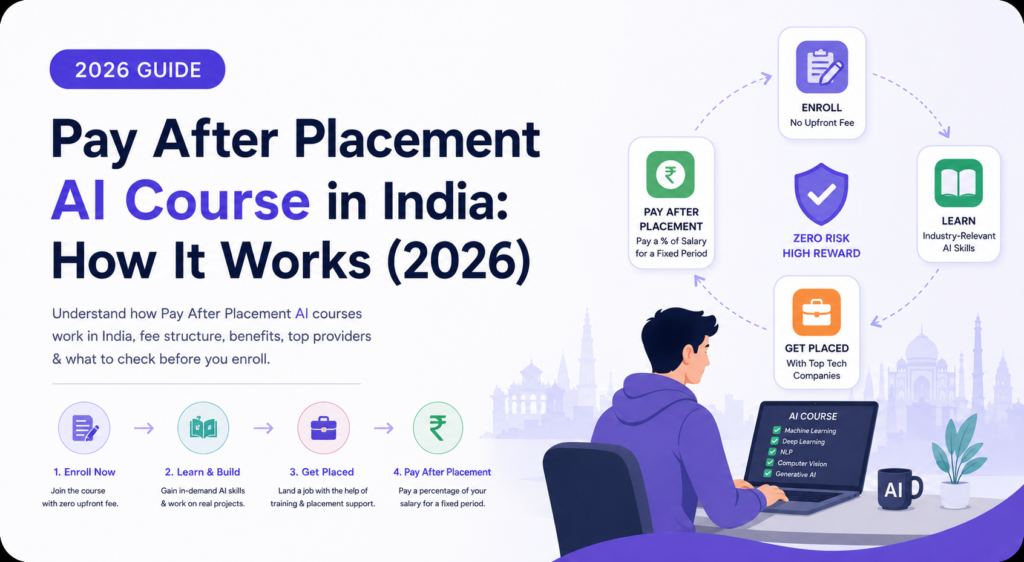
Here’s how a typical pay after placement AI course works in India, step by step:
- Enroll with a small token fee. You pay a minimal registration amount to reserve your seat.
- Learn and build. You go through the curriculum — Python, machine learning, deep learning, LLMs, RAG, and MLOps — and build real AI projects for your portfolio.
- Get placement support. The program runs mock interviews, resume and LinkedIn reviews, and connects you with hiring partners.
- Get placed, then pay. Once you land a job at or above the agreed CTC, you pay the remaining fee (often in EMIs).
This “learn now, pay after you’re hired” structure is what makes a pay-after-placement AI course so attractive to working professionals who can’t risk a large upfront investment.
Pay After Placement vs ISA: The Difference You Must Understand
This is the most important part of this guide. “Pay after placement” is marketing language — underneath, there are two very different financial models:
- Fixed-fee pay after placement: You pay a fixed, capped course fee after placement (for example, ₹1–2 lakh in EMIs). You know the exact total cost up front.
- Income Share Agreement (ISA): You pay a percentage of your salary (often 15–20%) for a set period (often 2 years). On a good salary, an income share agreement can quietly cost 2–3× more than a fixed fee.
Always ask one question: “Is this a fixed fee or an income share agreement?” A genuine, transparent pay after placement AI course tells you the exact maximum you’ll ever pay. If the answer is vague, or tied to a percentage of your future salary for years, treat it as a red flag.
Who Should Choose a Pay After Placement AI Course?
A pay after placement AI course is ideal if you:
- Are a working professional or fresh graduate who can’t pay lakhs upfront.
- Want accountability — a program that only profits when you actually get hired.
- Are switching from a non-AI role and need structured placement support.
- Value mentorship, real projects, and interview prep over passive, self-paced videos.
If you already have AI experience and just need a certificate, a cheaper self-paced course may be enough. But if your goal is a genuine career switch with a job at the end, a fixed-fee pay-after-placement AI course is one of the safest bets in 2026.
What to Look For in a Genuine Pay After Placement AI Course
Before you enroll in any pay after placement AI course in India, check these green flags:
- A clear, capped fee — not an open-ended ISA.
- A transparent CTC threshold that triggers payment, in writing.
- A real, verifiable placement record and named hiring partners.
- Industry-experienced mentors (ideally from product or MAANG companies).
- A modern, job-ready curriculum — LLMs, RAG, fine-tuning, and MLOps, not outdated theory.
- Real portfolio projects you can actually show in interviews.
- A written refund or exit clause if you leave or aren’t placed.
Red Flags to Avoid
Not every program advertising “pay after placement” is trustworthy. Walk away if you see:
- “Pay after placement” that turns out to be a multi-year ISA.
- A vague or unrealistically high guaranteed CTC.
- “100% placement guarantee” with no verifiable proof.
- An outdated curriculum with no generative AI or hands-on projects.
- Pressure to sign immediately, or hidden charges buried in the contract.
Typical Fees and Salary Outcomes in India
For context, fixed-fee pay after placement AI courses in India usually cost ₹1–2 lakh total, payable in EMIs after you’re placed, with guaranteed CTC thresholds commonly around ₹6–8 LPA for the payment to kick in. Strong programs report average placements of ₹9–12 LPA and top outcomes well above ₹40 LPA. Because GenAI and MLOps skills command a premium, graduates who build real projects often negotiate significantly higher offers.
Is a Pay After Placement AI Course Worth It?
For most serious career switchers, a fixed-fee pay after placement AI course is absolutely worth it. It lowers your financial risk, forces the institute to deliver real outcomes, and lets you train for a high-paying AI career without a huge upfront bet. NASSCOM projects India will need over a million AI professionals, and AI engineers earn 2–3× more than traditional developers — so the upside is enormous.
The catch is in the fine print. A fair, capped pay-after-placement AI course is one of the safest ways to switch careers in 2026. An ISA dressed up as “pay after placement” can end up costing far more than an honest upfront course — so always confirm the model before you sign.
NUVIQ’s Pay-After-Placement Model
NUVIQ is built around a transparent, fixed-fee pay-after-placement model — not an ISA. With NUVIQ, 60% of your fee is payable only after you’re placed, so most of your investment is tied directly to your outcome. You’ll train for 12 weeks with MAANG mentors, build real GenAI projects (RAG systems, fine-tuned LLMs, and multi-agent apps), earn industry certifications, and get direct referrals to 50+ partner companies. See exactly how our pay-after-placement structure works, explore the curriculum, and check the placement results.
Ready to switch careers without the upfront risk? Chat with an AI expert and find out if you’re a fit.
Frequently Asked Questions
What is a pay after placement AI course?
A pay after placement AI course is an AI/ML training program where you pay most of the fee only after you’re placed in a job at or above an agreed CTC, usually after a small token fee to enroll.
Is a pay after placement AI course really free until you get a job?
You typically pay a small registration or token fee upfront; the main course fee is due only after placement. Always confirm whether that post-placement fee is a fixed amount or an income share agreement.
What’s the difference between pay after placement and an ISA?
A fixed-fee pay after placement course charges a capped amount after placement. An income share agreement (ISA) charges a percentage of your salary for a fixed period, which can cost 2–3× more.
Which is the best pay after placement AI course in India?
The best pay after placement AI course is one with a capped fee (not an ISA), a verifiable placement record, MAANG-level mentors, and a modern GenAI curriculum with real, hands-on projects.
What CTC do pay after placement AI courses guarantee?
Most pay after placement AI courses in India set a guaranteed CTC threshold around ₹6–8 LPA, above which the post-placement fee becomes payable. Always confirm the exact figure in writing.
Final Word
A pay after placement AI course can sound almost too good to be true: learn in-demand AI and GenAI skills now, and pay most of the fee only after you land a job. For working professionals and career switchers in India who are nervous about spending lakhs upfront, the pay-after-placement model removes the single biggest risk. But not every “pay after placement” AI course is built the same — some are genuine, outcome-first programs, while others are income-share agreements in disguise that quietly cost 2–3× more. This 2026 guide explains exactly how a pay after placement AI course works in India, the fine print to check, the red flags to avoid, and how to choose the right one.